The Holding Environment: What Development Actually Requires
There is a moment in any genuine developmental journey when understanding alone is not enough. When knowing where you are going, and even knowing the path, doesn't move you forward on its own. What moves you forward is the environment around you: whether it holds you well enough to take the next risk, challenges you enough to make staying still feel insufficient, and understands you well enough to offer the right kind of both.
Robert Kegan called this the holding environment. It is one of the most important concepts in developmental psychology, and one of the least known outside academic circles (Kegan, 1982, 1994). That is worth correcting, because it describes something every human being needs and very few human beings have ever been able to name.
What a Holding Environment Actually Is
Kegan borrowed the term from the pediatrician and psychoanalyst Donald Winnicott, who used it to describe what a good-enough parent provides for a young child: a context safe enough to be in, and spacious enough to grow in (Kegan, 1982; Winnicott, 1965). Kegan extended the concept across the entire lifespan. A holding environment, in his framework, is any context, a relationship, a family, a school, a workplace, a therapeutic relationship, a community, that simultaneously confirms a person where they are and challenges them toward where they are going (Kegan, 1982, 1994).
That word simultaneously is doing a great deal of work. A holding environment is not first supportive and then challenging, or sometimes one and sometimes the other. It holds both at once. It says: you are enough as you are, and you are capable of more. It provides the safety that makes risk possible and the expectation that makes safety insufficient on its own.
Kegan was precise about what this requires. A holding environment must attend, at the same time, to the stage from which a person is transitioning and the stage toward which they are moving (Kegan, 1982). It must understand where someone actually is, not where we wish they were or where they were last year, and it must hold a genuine belief in where they are going. Without both, the environment either infantilizes or abandons. Neither supports development.
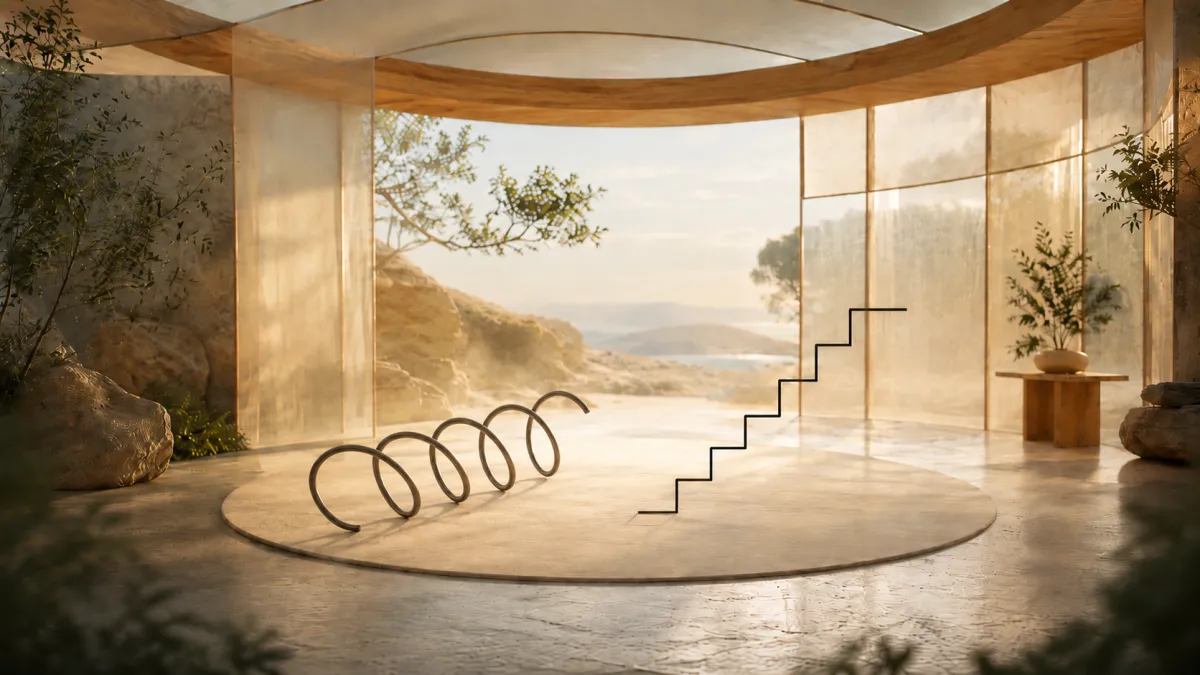
This is Baumrind's responsiveness and demandingness expressed at the level of the whole developmental context (Baumrind, 1991; Maccoby & Martin, 1983). It is Csikszentmihalyi's challenge and ability balance applied not just to a single task but to the entire surround of a person's life (Csikszentmihalyi, 1990). And it is, when understood through the lens of MacMillan's Spiral and Staircase Model™, something that looks meaningfully different depending on the neurology of the person the environment is holding.
What the Spiral Needs to Be Held
The non-autistic spiral is, as we have seen, a self-correcting system. It runs on continuous embodied feedback and carries a built-in adaptability that allows it to read situations in real time and adjust (Craig, 2009; Gallese, 2007). This might suggest that the spiral doesn't need much holding. That would be a mistake.
What the spiral needs from its holding environment is relational reflection. Because non-autistic identity forms partly through the back-and-forth of mutual social perception, through the experience of being genuinely seen and having that seeing reflected back, the spiral depends on environments populated by people who are actually present to it. Not managing it. Not accommodating it from a distance. Present to it, in genuine reciprocal contact.
When the holding environment fails to provide this, when the non-autistic person is surrounded by relationships that do not offer mutual reflection, the spiral's self-correcting mechanism begins to falter. The oscillation that drives growth can become dysregulated. The person may find themselves either rigidly defended against social feedback or excessively dependent on it, having lost the healthy middle ground where the spiral moves most freely.
In neurodiverse relational contexts, this is a real and underacknowledged risk. Non-autistic people in close relationships with autistic people, as partners, parents, siblings, children, are often navigating environments where the mutual body empathy reciprocation they depend on is not available in the same form (Milton, 2012). The holding environment for the non-autistic spiral in those contexts needs to include relationships outside that primary context where genuine mutual reflection can occur. This is not a criticism of autistic people. It is a description of what non-autistic neurology structurally requires.
The spiral also needs its holding environment to allow the oscillation. To not pathologize the moments of self-doubt and reconsideration that are the mechanism of growth. To understand that when a non-autistic person is curving back on the spiral, reorganizing their understanding, sitting with uncertainty, they are not failing. They are developing. An environment that demands constant forward confidence from a non-autistic person is not holding them well. It is interrupting the very process that needs supporting.
What the Staircase Needs to Be Held
The staircase has different requirements, and they are more specific, more explicit, and more dependent on the intentionality of the environment around it.
Where the spiral receives feedback continuously and largely automatically, the staircase needs feedback that is clear, direct, and calibrated to what the autistic nervous system can actually receive and use. This is not a small thing. Much of the feedback that non-autistic environments offer to autistic people is implicit, embodied, and delivered through precisely the social channels that are not the staircase's primary input (Crompton et al., 2020; Milton, 2012; Sasson et al., 2017). When a non-autistic teacher communicates disappointment through tone and expression rather than words, when a non-autistic partner signals hurt through withdrawal rather than direct statement, when a non-autistic colleague conveys approval through subtle social warmth rather than explicit acknowledgment, the staircase may not receive any of it. Not because the autistic person is not paying attention. Because the signal is being broadcast on a frequency the staircase does not automatically tune to.
A holding environment for the staircase makes the implicit explicit. It names what is happening. It offers clear information about how actions are landing and what is being asked. It does not mistake directness for coldness or explicitness for condescension. It understands that clarity is a form of respect.
The staircase also needs its holding environment to be patient with the horizontal surfaces. The periods of consolidation and application, when the autistic person is not visibly rising but is practicing and integrating what has already been learned, are not stagnation. They are necessary. An environment that interprets the horizontal surface as failure, that increases pressure or withdraws support during consolidation periods, is not holding the staircase. It is destabilizing it.
And critically, the holding environment for the staircase must not require camouflaging as the price of admission. Hull and colleagues, and Cage and Troxell-Whitman, documented the mental health costs of autistic people performing non-autistic social patterns in order to be accepted (Cage & Troxell-Whitman, 2019; Hull et al., 2017). A holding environment that demands this performance is not holding the staircase at all. It is asking the staircase to spend its developmental energy on disguise rather than growth. The two cannot happen simultaneously.
The Environment We Have Not Yet Built
Here is the honest assessment that this framework requires: for most autistic people, across most of history, the holding environment has not existed. Not adequately. Not consistently. Not in the form the staircase actually needs.
Lerner and colleagues asked autistic adults and caregivers what had helped and harmed their development across the lifespan. Relational support from other people was identified more frequently than any specific intervention or service (Lerner et al., 2025). People, not programs. Presence, not prescription. The holding environment, when it existed, was usually a person or a small group of people who understood, accepted, and expected something of the autistic person at the same time. When it was absent, the staircase extended its horizontal surfaces, sometimes for years, sometimes for decades.
Davies and colleagues, and Cooper and colleagues, found that positive autistic identity, one of Erikson's central developmental achievements, is powerfully shaped by external acceptance and support (Cooper et al., 2023; Davies et al., 2024). Identity does not form in a vacuum. It forms in relationship, in environment, in the experience of being genuinely held while being genuinely challenged. When that holding is absent, identity formation suffers. Not because the autistic person lacks the capacity for identity, but because the conditions that allow identity to form have not been provided.
This is not a counsel of despair. It is a counsel of responsibility. The holding environment can be built. It can be built in families, in schools, in clinical relationships, in friendships, in intimate partnerships, in communities. It requires understanding what each neurotype actually needs, which is what this framework is designed to provide. And it requires the willingness to build differently for different needs, not because different means lesser, but because equal outcomes require different conditions.
Holding Both at Once
One final thing needs to be said, because it is easy to miss and important not to.
In neurodiverse relational contexts, where autistic and non-autistic people are in close relationship with each other, both people need holding environments. Both the spiral and the staircase need to be held. And the conditions each requires are different enough that meeting both simultaneously is genuinely complex.
The non-autistic person needs mutual reflection and permission to oscillate. The autistic person needs explicit feedback and freedom from the demand to camouflage. These needs do not cancel each other out, but they do require that everyone in the system, and sometimes the professionals supporting the system, understands what each person is actually working with.
What this framework offers is not a simple solution. It offers something more valuable: a way of seeing clearly. When we understand that the spiral and the staircase have different structural requirements, we stop expecting the staircase to perform like a spiral and stop wondering why the spiral seems so destabilized. We start asking the right questions. What does this person's neurology actually need from this environment? What would a genuine holding environment look like for them, specifically, at this stage of their journey?
Those are the questions that lead somewhere. And they lead, when answered well, toward the same destination for everyone.
Trust. Autonomy. Initiative. Identity. Intimacy. Generativity. Integrity.
Both paths. Both held. Both rising.
Next in this series: The Destination Is the Same, Erikson's full arc across neurologies, and what it means to arrive.
This article is part of an ongoing series on MacMillan's Spiral and Staircase Model™ of psychosocial development across neurologies:
Article 1. The Gap: Why Developmental Psychology has Never Fully Accounted for Autism
Article 2. The Engine of Development: What Growth Requires Across all Neurologies
Article 3. Two Paths Upward: MacMillan's Spiral and Staircase Models of Psychosocial Development
Article 4. The Holding Environment: What Development Actually Requires
Article 5. The Destination is the Same: Erikson's Full Arc Across Neurologies
References
Baumrind, D. (1991). The influence of parenting style on adolescent competence and substance use. The Journal of Early Adolescence, 11(1), 56–95. https://doi.org/10.1177/0272431691111004
Cage, E., & Troxell-Whitman, Z. (2019). Understanding the reasons, contexts and costs of camouflaging for autistic adults. Journal of Autism and Developmental Disorders, 49(5), 1899–1911. https://doi.org/10.1007/s10803-018-03878-x
Cooper, K., Russell, A. J., Lei, J., & Smith, L. G. E. (2023). The impact of a positive autism identity and autistic community solidarity on social anxiety and mental health in autistic young people. Autism, 27(3), 848–857. https://doi.org/10.1177/13623613221118351
Craig, A. D. (2009). How do you feel—now? The anterior insula and human awareness. Nature Reviews Neuroscience, 10(1), 59–70. https://doi.org/10.1038/nrn2555
Crompton, C. J., Ropar, D., Evans-Williams, C. V. M., Flynn, E. G., & Fletcher-Watson, S. (2020). Autistic peer-to-peer information transfer is highly effective. Autism, 24(7), 1704–1712. https://doi.org/10.1177/1362361320919286
Csikszentmihalyi, M. (1990). Flow: The psychology of optimal experience. Harper & Row.
Davies, J., Cooper, K., Killick, E., Sam, E., Healy, M., Thompson, G., Mandy, W., Redmayne, B., & Crane, L. (2024). Autistic identity: A systematic review of quantitative research. Autism Research, 17(5), 874–897. https://doi.org/10.1002/aur.3105
Erikson, E. H. (1963). Childhood and society (2nd ed.). W. W. Norton.
Erikson, E. H. (1980). Identity and the life cycle. W. W. Norton.
Gallese, V. (2007). Before and below “theory of mind”: Embodied simulation and the neural correlates of social cognition. Philosophical Transactions of the Royal Society B: Biological Sciences, 362(1480), 659–669. https://doi.org/10.1098/rstb.2006.2002
Hull, L., Petrides, K. V., Allison, C., Smith, P., Baron-Cohen, S., Lai, M.-C., & Mandy, W. (2017). “Putting on my best normal”: Social camouflaging in adults with autism spectrum conditions. Journal of Autism and Developmental Disorders, 47(8), 2519–2534. https://doi.org/10.1007/s10803-017-3166-5
Kegan, R. (1982). The evolving self: Problem and process in human development. Harvard University Press.
Kegan, R. (1994). In over our heads: The mental demands of modern life. Harvard University Press.
Lerner, J. E., Schiltz, H., Schisterman, N., Ziegler, S., & Lord, C. (2025). What factors have been the most helpful and harmful and when? Identifying key impacts on psychosocial development according to autistic adults and caregivers. Journal of Autism and Developmental Disorders. https://doi.org/10.1007/s10803-025-06800-4
Maccoby, E. E., & Martin, J. A. (1983). Socialization in the context of the family: Parent-child interaction. In P. H. Mussen (Series Ed.) & E. M. Hetherington (Vol. Ed.), Handbook of child psychology: Vol. 4. Socialization, personality, and social development (4th ed., pp. 1–101). Wiley.
Milton, D. E. M. (2012). On the ontological status of autism: The “double empathy problem.” Disability & Society, 27(6), 883–887. https://doi.org/10.1080/09687599.2012.710008
Sasson, N. J., Faso, D. J., Nugent, J., Lovell, S., Kennedy, D. P., & Grossman, R. B. (2017). Neurotypical peers are less willing to interact with those with autism based on thin slice judgments. Scientific Reports, 7, Article 40700. https://doi.org/10.1038/srep40700
Winnicott, D. W. (1965). The maturational processes and the facilitating environment: Studies in the theory of emotional development. International Universities Press.


